

Adding a new appliance to your home should be a straightforward improvement, not the beginning of an electrical problem. But in Holly Springs, NC, where a mix of established neighborhoods like 12 Oaks and Braxton Village sit alongside newer developments that continue to expand throughout western Wake County, the electrical systems in residential properties vary widely in their age, capacity, and condition. When a breaker box starts buzzing shortly after a new appliance is installed, that sound is your electrical system communicating that something needs attention. Understanding what causes it and knowing when to call a professional can protect your home from more serious consequences.
Our Holly Springs electrical services are designed to respond to exactly these kinds of concerns, with licensed technicians who diagnose the root cause accurately and resolve it completely rather than applying a temporary fix.
What Causes a Breaker Box to Buzz After a New Appliance Installation?
In our service calls throughout Holly Springs, post-installation buzzing almost always points to one of a handful of identifiable causes. Understanding each one helps clarify why professional evaluation is the appropriate response.
Circuit overload is the most common culprit. When a new appliance draws more power than the circuit it is connected to was designed to handle, the breaker struggles to manage the load and produces a buzzing or vibrating sound as a result.
Improper grounding of the new appliance can also create electrical conditions that manifest as buzzing at the panel. A ground fault creates an imbalance in the circuit that the breaker detects but cannot resolve on its own.
Loose connections anywhere in the circuit, whether at the outlet, along the wiring run, or within the panel itself, allow electricity to arc across small gaps. That arcing produces both heat and the audible buzzing that homeowners notice.
A failing breaker mechanism is another possibility. Older or worn breakers with faulty internal components may begin buzzing under loads that a properly functioning breaker would handle without issue.
Regardless of the specific cause, the buzzing should be treated as a warning that the system is not operating correctly, and professional diagnosis is the safest path forward.
What the Troubleshooting Process Looks Like
When a licensed electrician from our team responds to a buzzing breaker box call in Holly Springs, NC, the diagnostic process follows a systematic approach designed to identify the root cause efficiently and safely.
The first step is evaluating the breaker that powers the new appliance, confirming it is properly positioned, and checking whether it has tripped. If the breaker has tripped and the buzzing persists after resetting, the focus shifts to identifying whether the cause is a loose connection, an overloaded circuit, or a failing breaker component.
A thorough inspection of the panel follows, checking for loose wiring, deteriorating connections, and any signs of arcing or heat damage. The electrical load on the affected circuit is then assessed against its rated capacity to determine whether the new appliance has pushed it beyond what the circuit was designed to support.
If the load evaluation confirms the circuit is undersized for the new appliance, upgrading the circuit or installing a dedicated line for that appliance is the appropriate solution. This kind of work requires a licensed electrician and should never be attempted without the proper training and equipment.
Common Causes and Solutions for Breaker Box Buzzing
A buzzing breaker box after an appliance installation generally falls into one of several categories, each with its own appropriate resolution.
Loose connections at any point in the circuit create arcing conditions that produce both heat and buzzing. Tightening connections and inspecting for any damage caused by prior arcing is the standard corrective action.
Overloaded circuits occur when the total electrical demand on a circuit exceeds its designed capacity. Adding a high-draw appliance such as a refrigerator, dishwasher, washing machine, or air conditioning unit to a circuit already carrying a significant load is a common trigger. The solution is either redistributing the load across multiple circuits or upgrading the circuit to handle the increased demand.
Faulty breakers that can no longer manage their rated load reliably need to be replaced. A breaker that buzzes, runs warm, or fails to trip properly has lost its protective function and represents a genuine hazard.
In situations where an appliance installation has revealed that the panel as a whole is struggling to meet the home’s electrical demands, a broader electrical panel upgrade may be the most practical and cost-effective long-term solution.
Situations When You Should Hire an Electrician for Breaker Box Buzzing
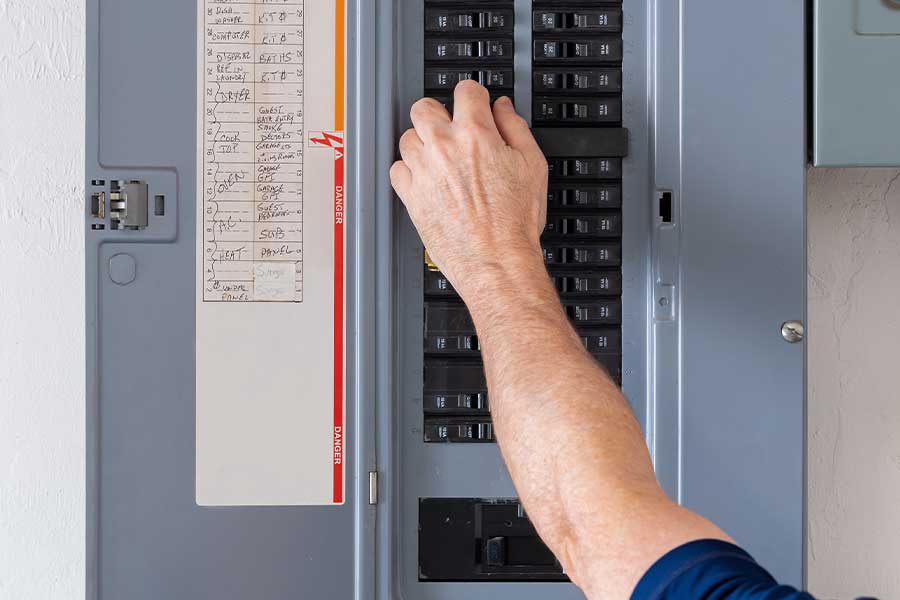
Some homeowners are tempted to open the panel and investigate a buzzing breaker box independently. This is a situation where that instinct should be set aside entirely. Electrical panels carry live current even when individual breakers are switched off, and the risks of shock, arc flash, and unintentional short circuits are very real without proper training, equipment, and licensure.
The following situations call for immediate professional attention:
- Ongoing breaker box buzzing or flickering lights following a new appliance installation
- Sparking or burning smells coming from the panel or nearby outlets
- Unexplained power outages or frequently tripping circuit breakers
- Installation of new high-powered appliances that may exceed circuit capacity
- Any visible signs of electrical system deterioration, including discoloration, scorch marks, or damaged wiring
Professional electrical repair services address each of these situations with the expertise, tools, and safety protocols that protect both the technician and your home. The risks of attempting these repairs independently are not worth the perceived savings.
Tips to Prevent Breaker Box Buzzing After Appliance Installations
Prevention is always more straightforward than repair, and a few proactive steps can significantly reduce the likelihood of buzzing and electrical issues following a new appliance installation.
Before any high-draw appliance is installed, verify that the circuit it will be connected to has sufficient capacity to handle the load. Appliances like electric ranges, dryers, dishwashers, and EV chargers typically require dedicated circuits rather than shared ones. A licensed electrician can assess this before installation begins, preventing problems rather than responding to them after the fact.
Ensure that connections at outlets and within the panel are secure and in good condition. Loose connections are one of the most preventable causes of post-installation buzzing, and they are straightforward to address during a pre-installation inspection.
Having a licensed electrician inspect the full electrical system before adding significant new loads is the most comprehensive preventive measure available. A circuit breaker installation or circuit upgrade performed proactively is far less disruptive than an emergency repair after something has already gone wrong.
Keeping Your Holly Springs Home Safe After Every Upgrade
Every home improvement that adds electrical demand to your system is an opportunity to verify that your electrical infrastructure is ready to support it. In a growing community like Holly Springs, where homeowners are continuously investing in their properties, staying ahead of electrical capacity is part of responsible homeownership.
If your breaker box has been buzzing since a recent appliance installation, or if you want a professional evaluation before adding new equipment to your home’s electrical system, contact our team today to schedule your service. Our licensed electricians are ready to help Holly Springs homeowners keep their electrical systems safe, capable, and performing reliably.